Dental Reference
Tooth Number Chart (1–32): Adult and Baby Teeth Guide
Identify adult teeth 1–32 and baby teeth A–T with this ADA Universal Numbering System chart, including tooth names, locations, and FDI equivalents.
TrustOral Editorial Team · · 12 min read
Have you heard your dentist mention tooth 3, 14, 19, or 30 and wondered which tooth they meant? This guide explains the Universal Numbering System commonly used in the United States, including every permanent and primary tooth designation.
What Is a Tooth Number Chart?
A tooth number chart identifies each tooth by a standard number or letter. Dental professionals use these designations when documenting examinations, discussing treatment, preparing claims, and reviewing clinical records.
- • Permanent adult teeth use numbers 1 through 32.
- • Primary (baby) teeth use letters A through T.
- • Tooth 1 is the upper right third molar, and tooth 16 is the upper left third molar.
- • Tooth 17 is the lower left third molar, and tooth 32 is the lower right third molar.
Adult Tooth Number Chart: Teeth 1–32
A complete permanent dentition contains up to 32 teeth, including four third molars. Numbering begins at the upper right wisdom-tooth position, crosses the upper arch, then continues from the lower left wisdom-tooth position across the lower arch.
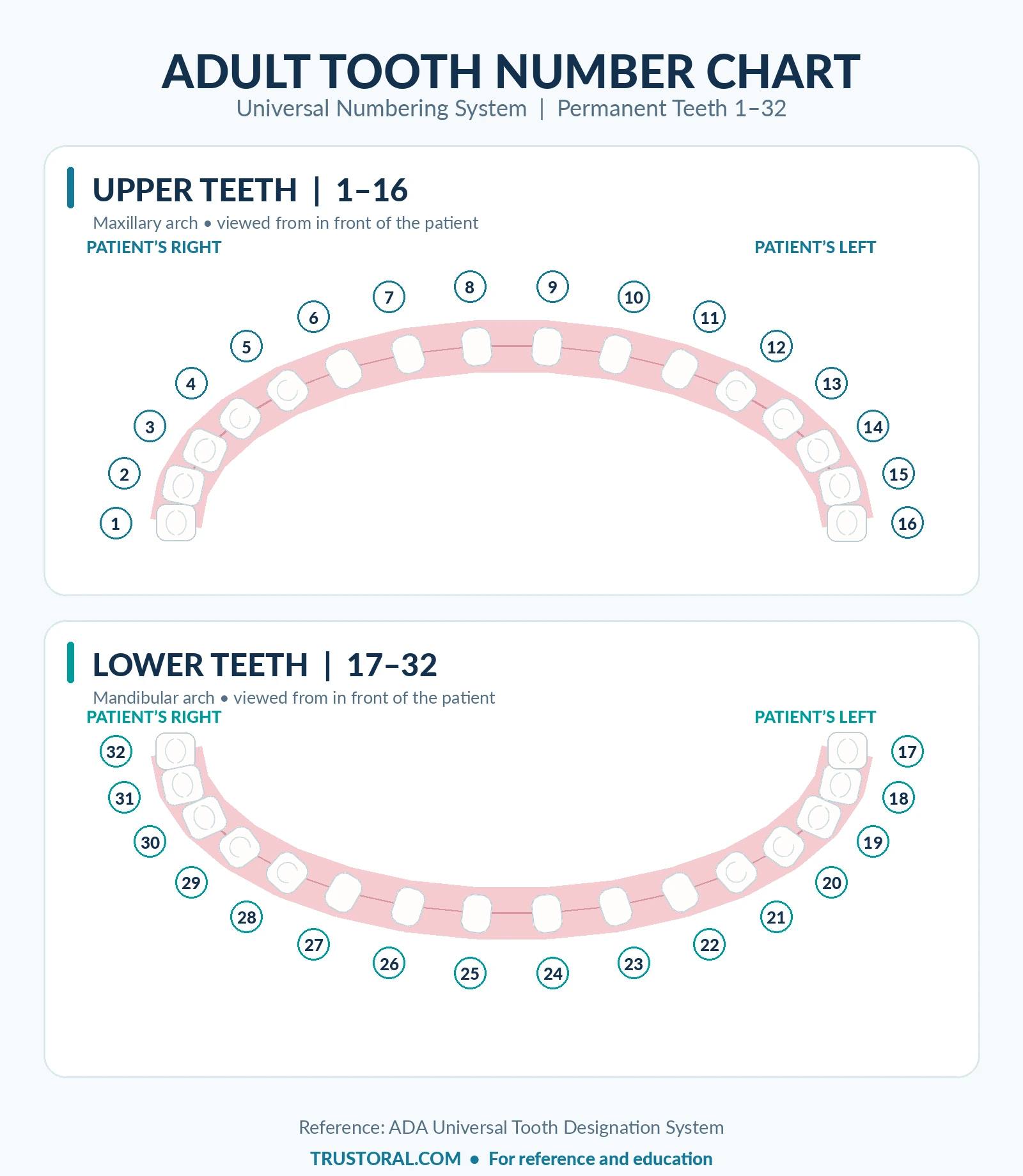
Adult teeth numbering—quick reference
| Dental arch | Patient's right (your left) | Patient's left (your right) |
|---|---|---|
| Upper teeth | 1 2 3 4 5 6 7 8 | 9 10 11 12 13 14 15 16 |
| Lower teeth | 32 31 30 29 28 27 26 25 | 24 23 22 21 20 19 18 17 |
Complete adult tooth numbers and names
| Tooth | Name and location | FDI |
|---|---|---|
| 1 | Upper right third molar (wisdom tooth) | 18 |
| 2 | Upper right second molar | 17 |
| 3 | Upper right first molar | 16 |
| 4 | Upper right second premolar | 15 |
| 5 | Upper right first premolar | 14 |
| 6 | Upper right canine | 13 |
| 7 | Upper right lateral incisor | 12 |
| 8 | Upper right central incisor | 11 |
| 9 | Upper left central incisor | 21 |
| 10 | Upper left lateral incisor | 22 |
| 11 | Upper left canine | 23 |
| 12 | Upper left first premolar | 24 |
| 13 | Upper left second premolar | 25 |
| 14 | Upper left first molar | 26 |
| 15 | Upper left second molar | 27 |
| 16 | Upper left third molar (wisdom tooth) | 28 |
| 17 | Lower left third molar (wisdom tooth) | 38 |
| 18 | Lower left second molar | 37 |
| 19 | Lower left first molar | 36 |
| 20 | Lower left second premolar | 35 |
| 21 | Lower left first premolar | 34 |
| 22 | Lower left canine | 33 |
| 23 | Lower left lateral incisor | 32 |
| 24 | Lower left central incisor | 31 |
| 25 | Lower right central incisor | 41 |
| 26 | Lower right lateral incisor | 42 |
| 27 | Lower right canine | 43 |
| 28 | Lower right first premolar | 44 |
| 29 | Lower right second premolar | 45 |
| 30 | Lower right first molar | 46 |
| 31 | Lower right second molar | 47 |
| 32 | Lower right third molar (wisdom tooth) | 48 |
For example, tooth 30 is the lower right first molar. The same tooth is designated 46 in the FDI two-digit system.
The Four Types of Adult Teeth
Incisors—the front teeth
Incisors are the relatively thin cutting teeth at the front of the mouth. Adults typically have eight: teeth 7, 8, 9, 10, 23, 24, 25, and 26.
Canines—the pointed teeth
Canines, also called cuspids, sit beside the lateral incisors and help grip and tear food. The four adult canines are teeth 6, 11, 22, and 27.
Premolars—the transitional teeth
Premolars sit between the canines and molars. Adults typically have eight: teeth 4, 5, 12, 13, 20, 21, 28, and 29.
Molars—the back teeth
Molars have broad chewing surfaces. A complete adult dentition has 12 molars when all four wisdom teeth are present: 1, 2, 3, 14, 15, 16, 17, 18, 19, 30, 31, and 32.
Baby Teeth Number Chart: Letters A–T
Children have 20 primary teeth, also called baby or deciduous teeth. The U.S. Universal Numbering System identifies them with letters A through T. Primary teeth include eight incisors, four canines, and eight molars—there are no primary premolars.
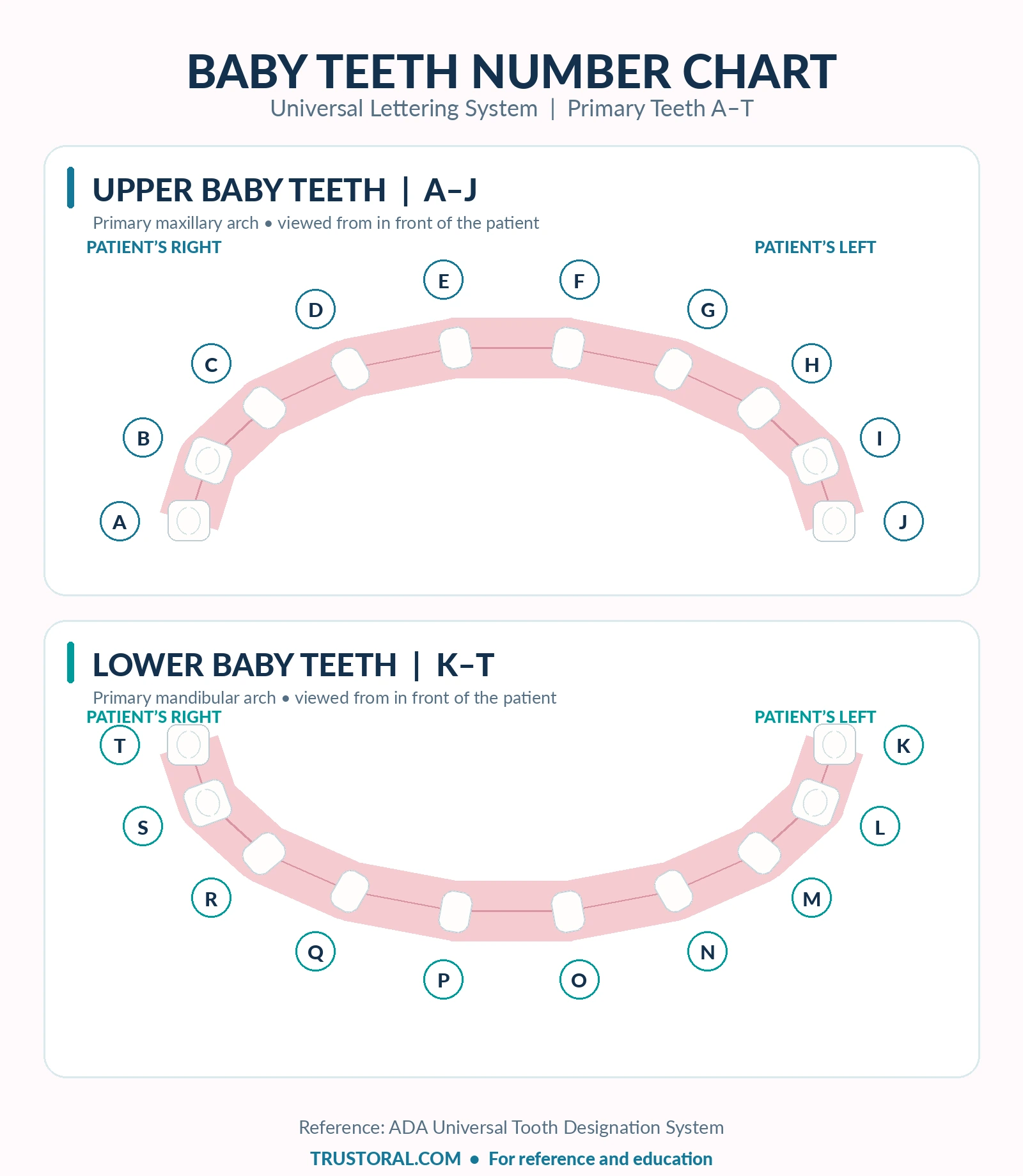
Baby teeth lettering—quick reference
| Dental arch | Patient's right (your left) | Patient's left (your right) |
|---|---|---|
| Upper baby teeth | A B C D E | F G H I J |
| Lower baby teeth | T S R Q P | O N M L K |
Complete primary teeth chart
| Letter | Baby tooth name and location |
|---|---|
| A | Upper right second molar |
| B | Upper right first molar |
| C | Upper right canine |
| D | Upper right lateral incisor |
| E | Upper right central incisor |
| F | Upper left central incisor |
| G | Upper left lateral incisor |
| H | Upper left canine |
| I | Upper left first molar |
| J | Upper left second molar |
| K | Lower left second molar |
| L | Lower left first molar |
| M | Lower left canine |
| N | Lower left lateral incisor |
| O | Lower left central incisor |
| P | Lower right central incisor |
| Q | Lower right lateral incisor |
| R | Lower right canine |
| S | Lower right first molar |
| T | Lower right second molar |
What Are the Three Tooth Numbering Systems?
1. Universal Numbering System
The Universal System uses 1–32 for permanent teeth and A–T for primary teeth. It is the system most commonly used by dental professionals in the United States.
2. FDI World Dental Federation System
The FDI system uses two digits. For permanent teeth, the first digit identifies the quadrant (1 upper right, 2 upper left, 3 lower left, 4 lower right), while the second identifies the position from the center, 1 through 8. Primary teeth use quadrant digits 5 through 8 and position digits 1 through 5.
3. Palmer Notation System
Palmer notation divides the mouth into four quadrants and combines a quadrant symbol with a position. Permanent teeth are numbered 1 through 8 from the center of each quadrant; primary teeth use A through E.
Common Tooth Numbers Explained
| Tooth number | Location |
|---|---|
| 3 | Upper right first molar |
| 8 | Upper right central incisor |
| 14 | Upper left first molar |
| 19 | Lower left first molar |
| 30 | Lower right first molar (FDI 46) |
| 1, 16, 17, 32 | The four wisdom-tooth positions |
Why Tooth Numbering Matters in Dental Records
Consistent tooth identification helps teams communicate which tooth is being examined or treated. A tooth number alone may not be sufficient: depending on the procedure, the record may also need tooth surfaces, findings, diagnosis, materials, and other relevant details.
Documentation items practices may review
- • A tooth number that differs between the clinical note and treatment plan.
- • Missing tooth-surface details where they are required.
- • Inconsistent notation between providers or imported records.
- • Unclear documentation of a missing or previously extracted tooth.
- • A record that does not sufficiently explain the treatment performed.
Supporting Better Dental Documentation with TrustOral
Accurate tooth identification is one part of a clear dental record. TrustOral helps dental teams review documentation gaps, monitor supported regulatory sources, and coordinate follow-up work across permitted practice locations.
Frequently Asked Questions About Tooth Numbers
What tooth number chart is used in the USA?
The United States commonly uses the ADA-recognized Universal Numbering System. Permanent teeth are numbered 1–32, while primary teeth are lettered A–T.
What are the numbers of the two upper front teeth?
The upper central incisors are 8 and 9. Tooth 8 is on the patient's upper right, and tooth 9 is on the patient's upper left.
What numbers are the lower front teeth?
The lower central incisors are 24 and 25.
Which tooth is number 14?
Tooth 14 is the upper left first permanent molar in the Universal Numbering System.
Which tooth is number 19?
Tooth 19 is the lower left first permanent molar.
Which tooth is number 30?
Tooth 30 is the lower right first permanent molar. Its FDI equivalent is 46.
What numbers are wisdom teeth?
Wisdom teeth occupy positions 1, 16, 17, and 32.
Do all adults have 32 teeth?
No. Some people do not develop all third molars, have teeth that have not erupted, or have had teeth extracted.
How many teeth do children have?
A complete primary dentition contains 20 baby teeth: 10 in the upper jaw and 10 in the lower jaw.
Does a missing tooth change the numbering of other teeth?
No. Each number identifies an anatomical position, so the other tooth designations remain unchanged.